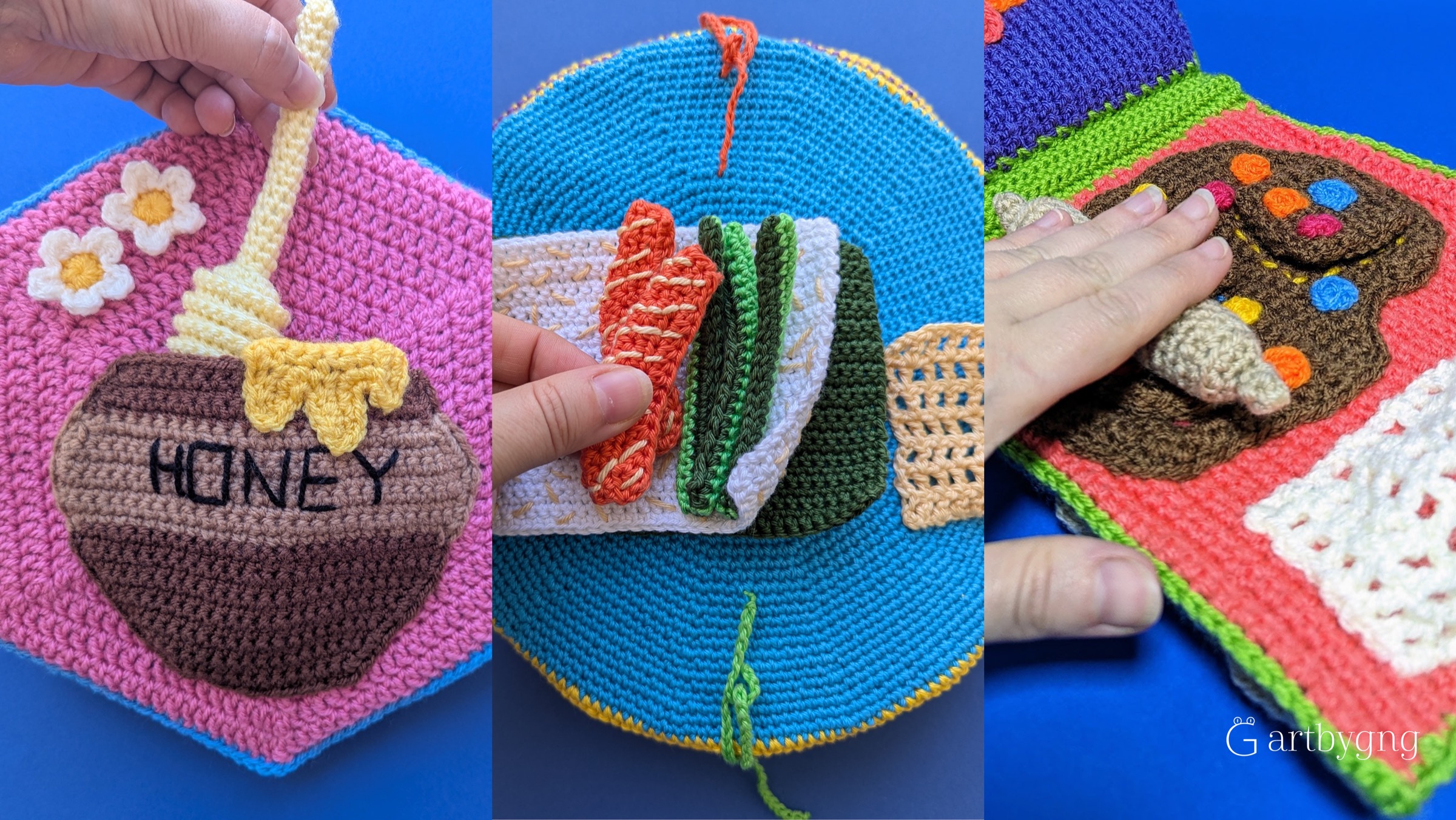
If you’re looking for crochet quiet book page ideas, the trick is to combine thinking about interactions with pictures. Every good page gives little hands something to do. It can be a thinking game, like sorting, counting, matching etc. - or it can be open ended teaching experiences about the world, like putting eggs into a mixer for a cake book. Below are 14 page ideas that all pass that test, each with what you’d actually crochet and how hard it is.
A quiet book (also called a busy book, activity book, or sensory book) is a soft, interactive book for babies and toddlers where every page is its own little game. If you’re new to the whole idea, start with my beginner’s guide to crocheting a quiet book — this post is the idea bank you raid once you know how a page is built.
All 14 page ideas at a glance:
- Decorate the cake — removable toppings
- Paint at the canvas — swap the paint blobs
- Feed the bees — pocket hive
- Stuff the taco — play-food pocket
- Fix it tools — do some play-home-improvement
- Match the socks — pairing game
- Count the apples on the tree — sorting + counting
- Match the cupcake to the liner — color matching
- Match the shapes — soft shape sorter
- Dress for the weather — a spinner + swap pieces
- Lace up the shoe — threading practice
- Get dressed: zip, snap, velcro — real fastenings
- Make a silly face — mix-and-match features
- Tuck teddy into bed — the bedtime page
Pick a handful, give them one theme, and you’ve designed a book. Here’s each one in detail.
1. Decorate the cake
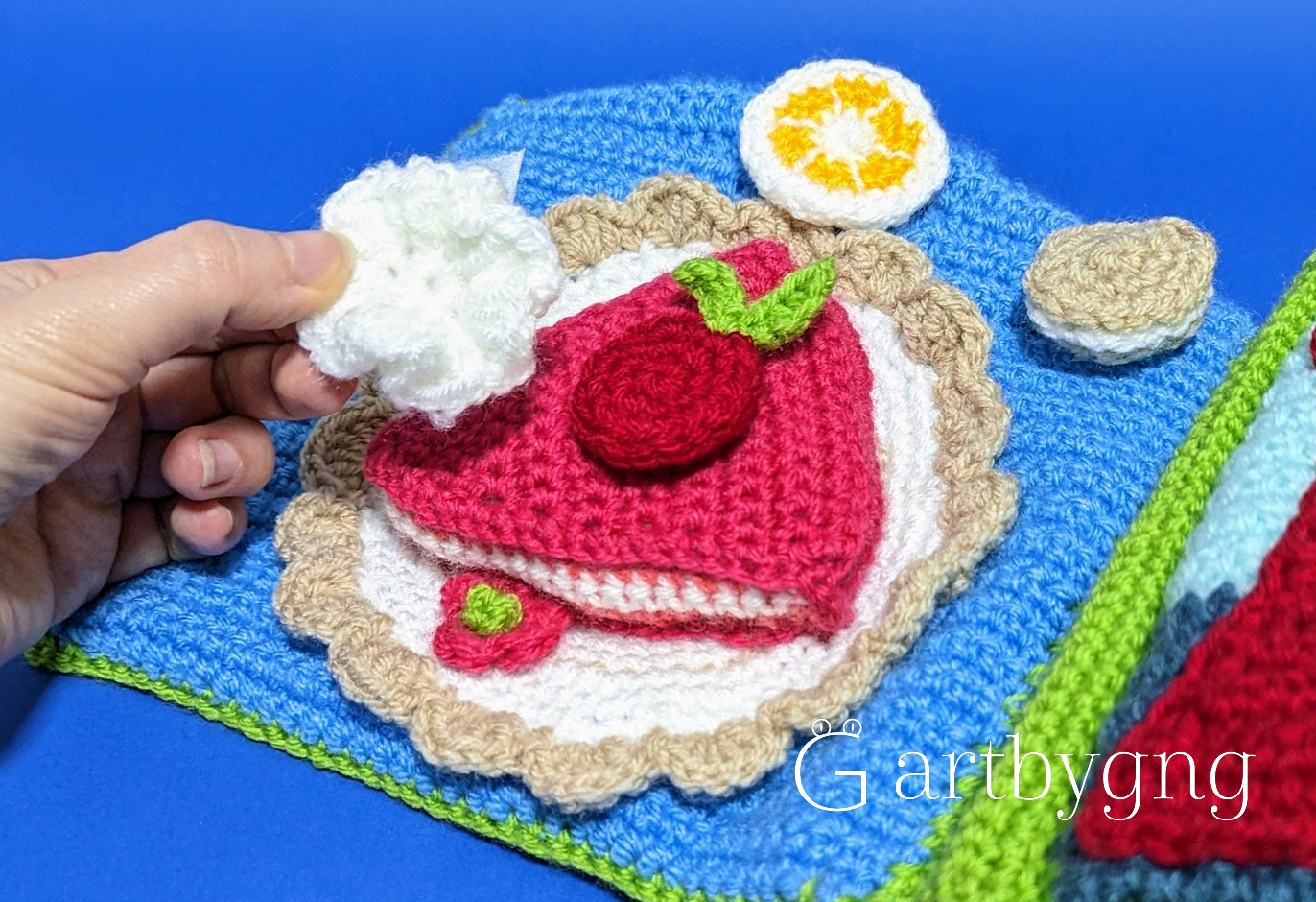
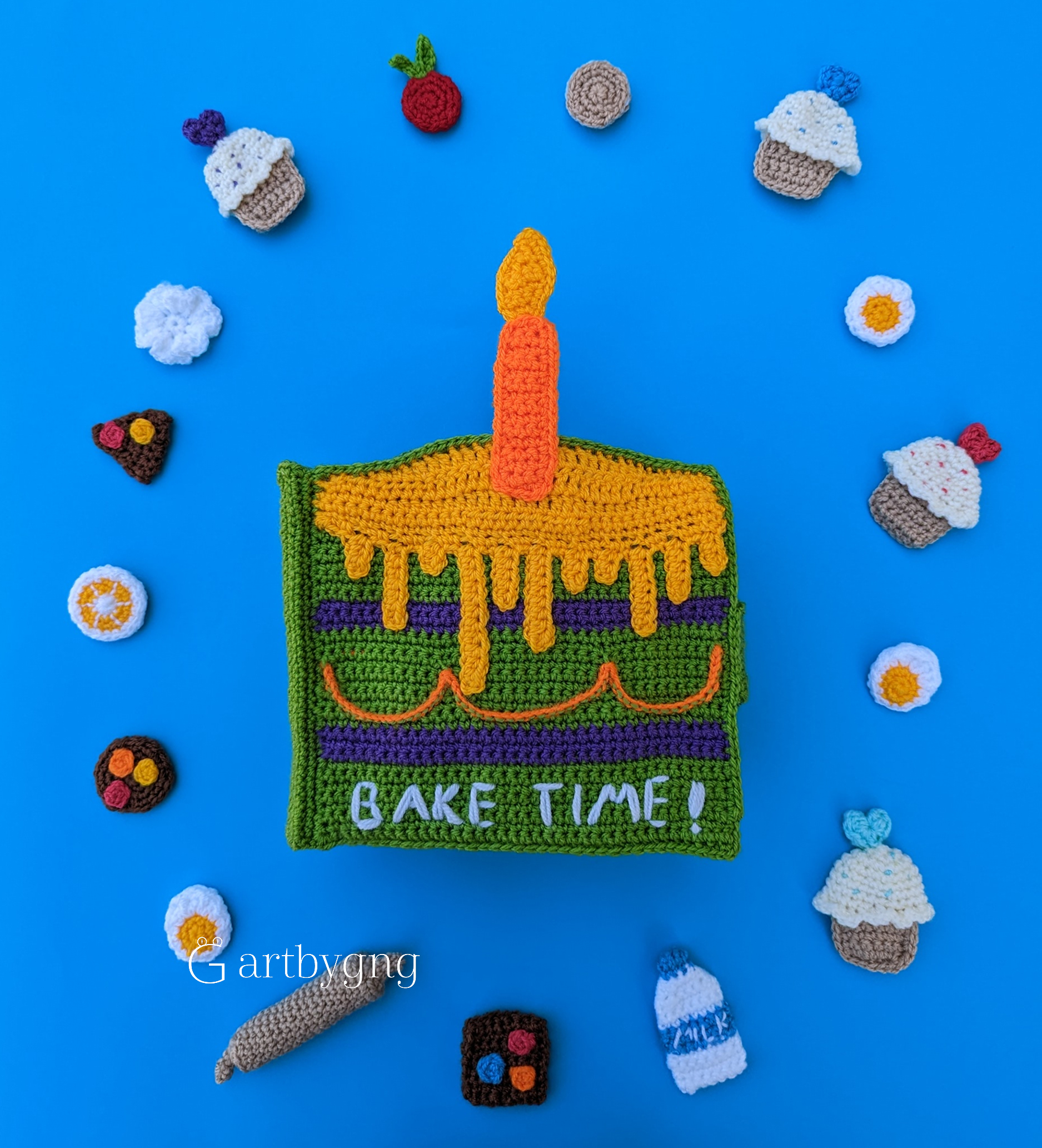
The interaction: little pieces that attach to a base and can get rearranged over and over again. A crocheted cake or cupcake base sits on the page, and removable toppings — candles, berries, frosting swirls — attach with Velcro so a toddler can “decorate” it as much as they like. It’s one of the fun and loved pages of the quiet book for a reason: it’s pretend play, fine-motor practice, and a birthday game all at once.
What you’d crochet: one flat or lightly-stuffed cake base, plus as many small toppings as you like.
Skill level: beginner-friendly — many of the instructions for different toppings can be found online and won’t take too long.
This is the heart of my Bake Time pattern, my bestselling quiet book pattern themed around baking, play-tested and photo-guided page by page.
2. Paint the canvas
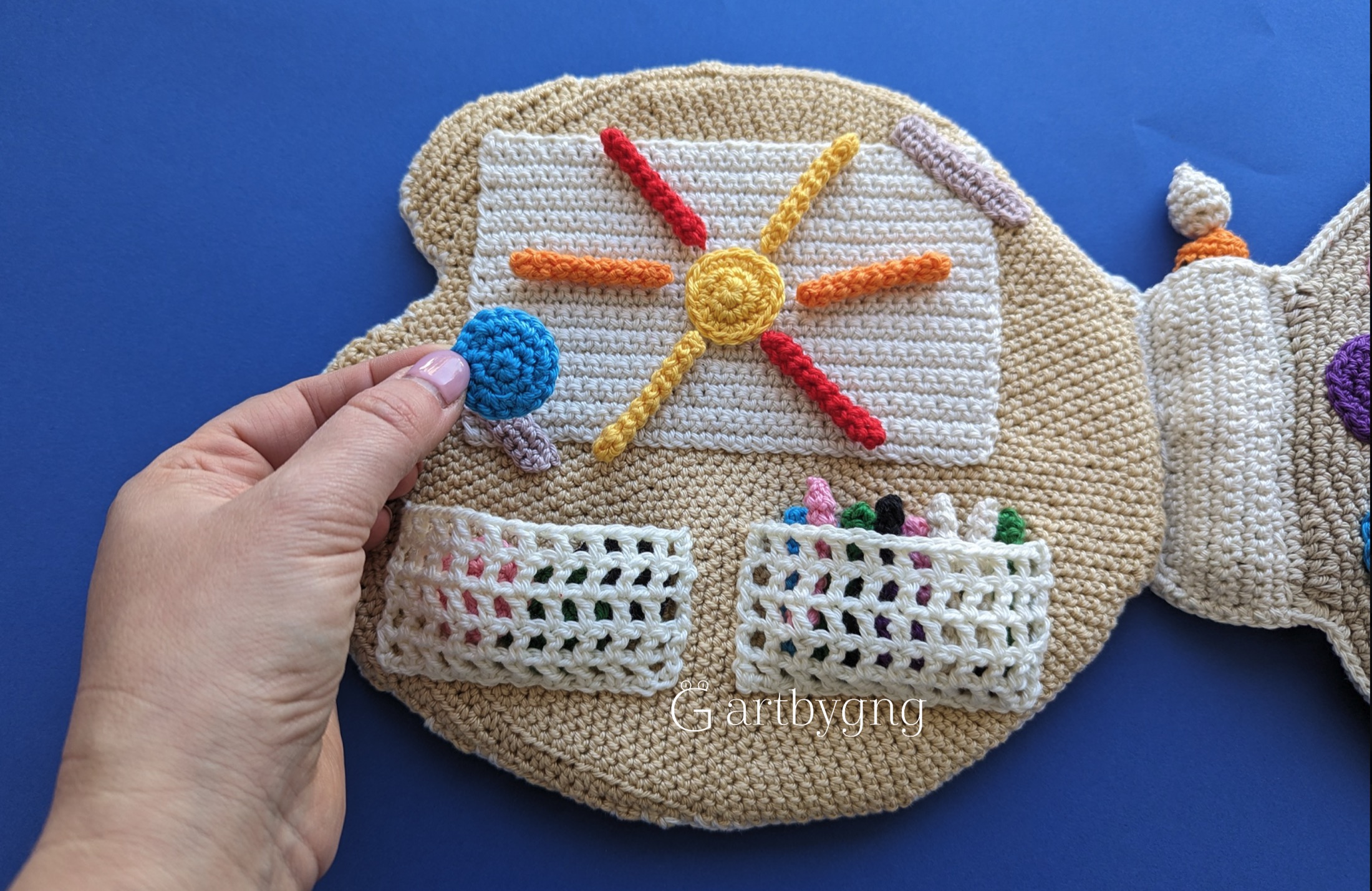
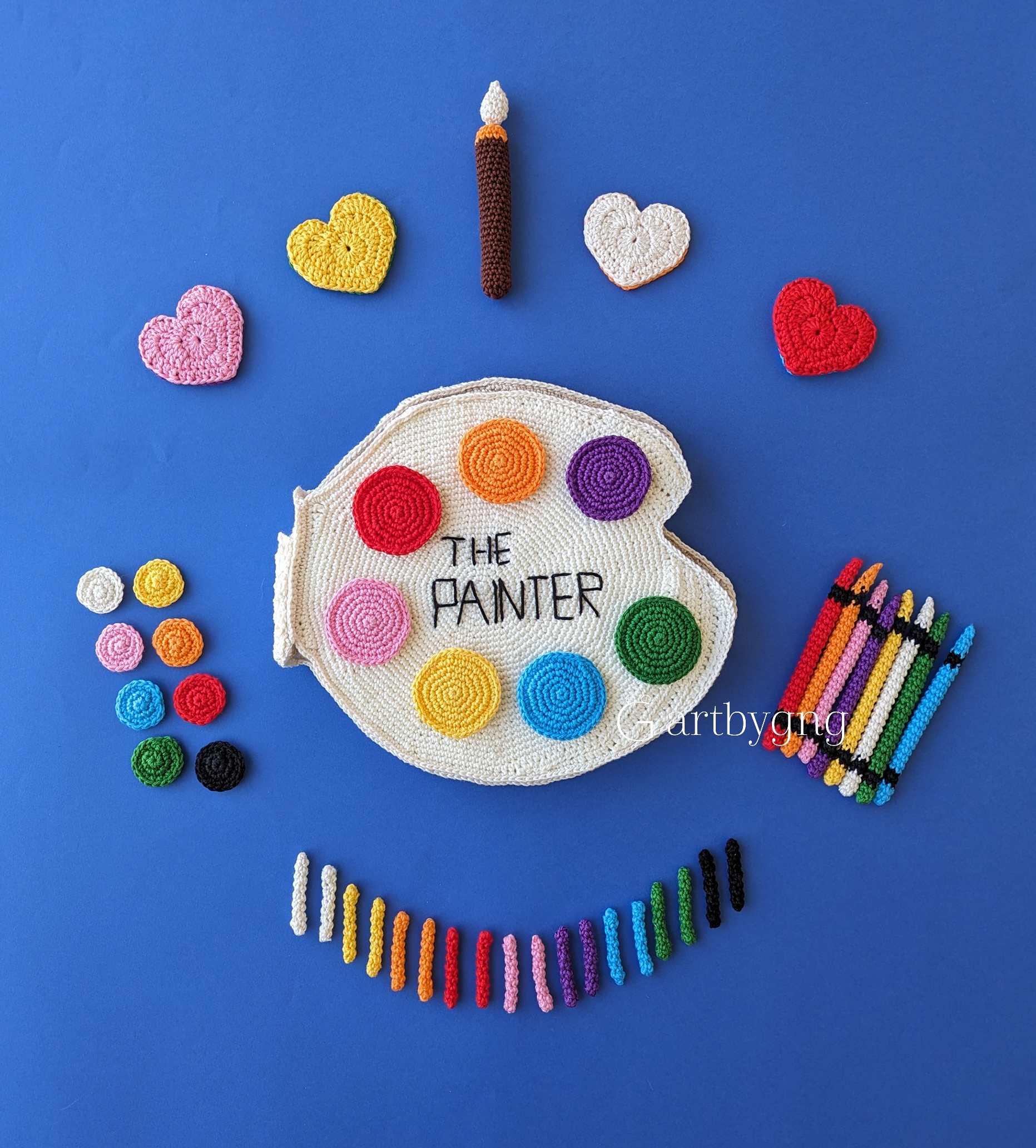
The interaction: creating “drawings” using crocheted pieces in different colors and shapes. this Montessori-styled game is a timeless classic. A canvas sits on the page, and little “paint blob” or brushstroke pieces come together so the toddler can “paint” a new picture every time. It’s creative play and fine-motor practice in one.
What you’d crochet: a flat easel shape (sewn to the page) and a set of colored paint blobs.
Skill level: beginner-friendly — all simple pieces, no stuffing required.
The picture above is from my Painter quiet book pattern and has many more similar ideas, if you’d like to use a pattern instead.
3. Feed the bees
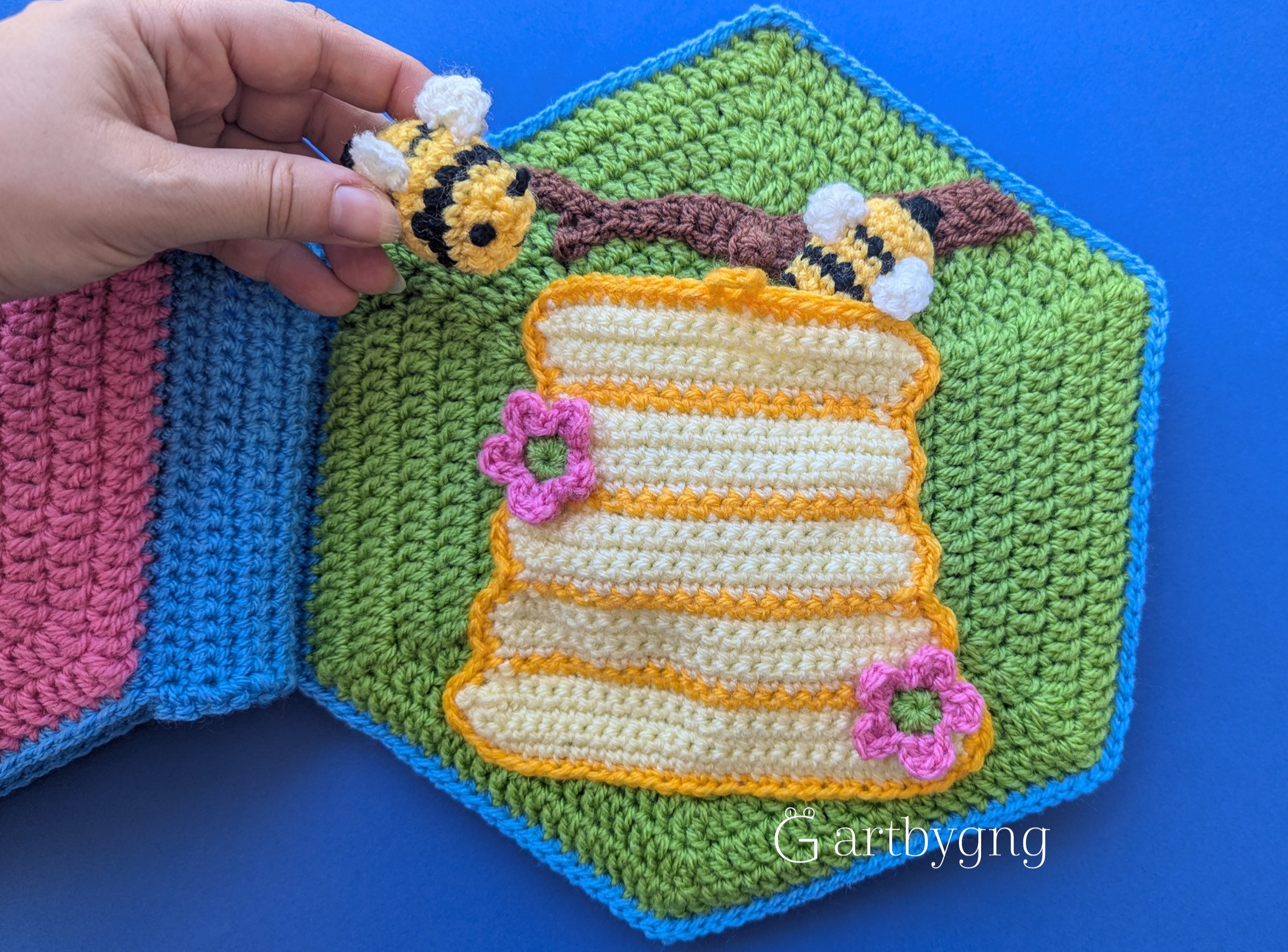
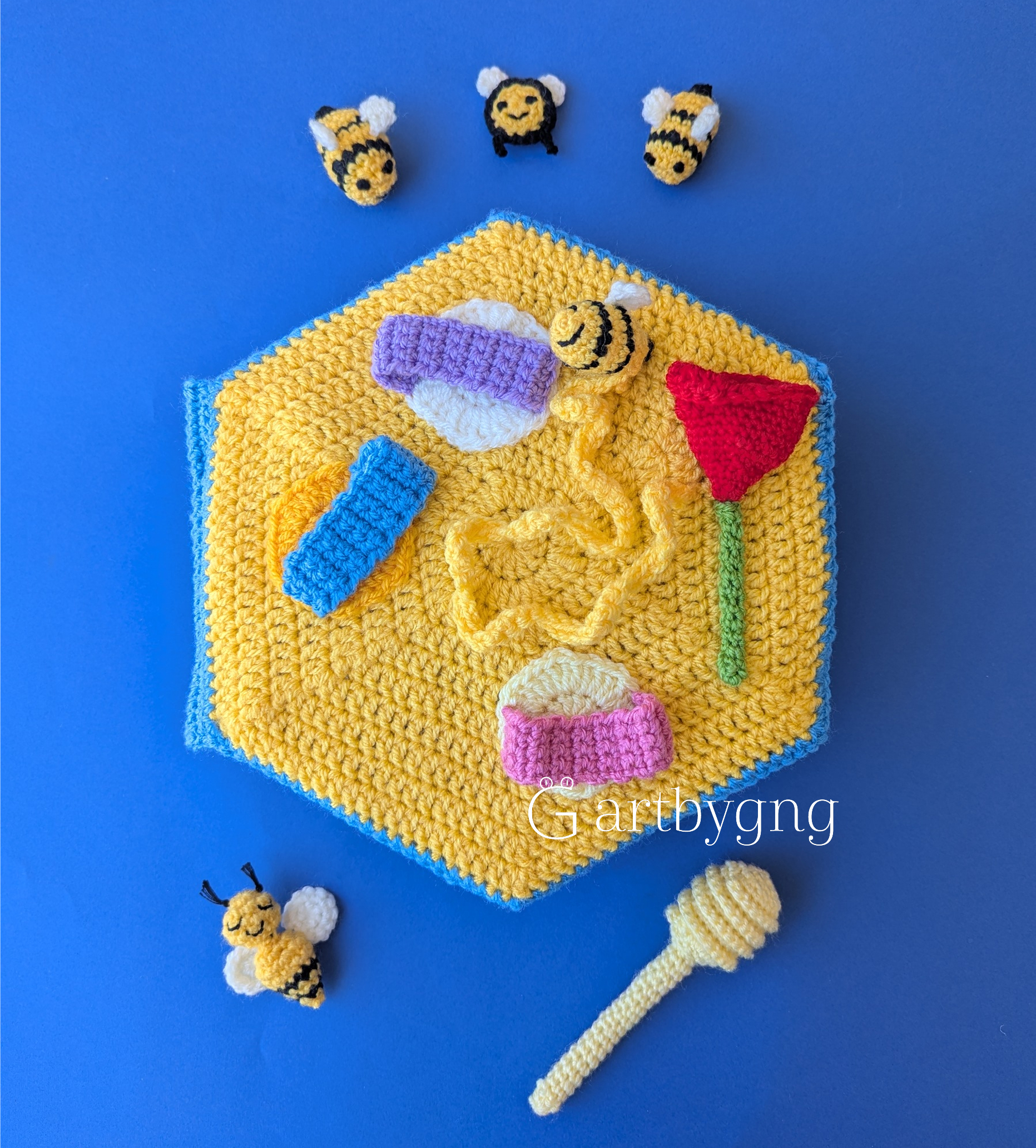
The interaction: play pieces that hide inside a pocket and come back out. Flowers decorate the page and a pocket hive waits for the bees. The toddler “feeds” the bees by flying them to the flowers and tucks them back into the hive. A fun tuck-and-retrieve game, with a tad of education built in.
What you’d crochet: a few flat flowers, a pocketed hive shape, and two or three small bees (small enough to fit in the pocket).
Skill level: beginner to intermediate — the hive’s shape is a bit more complex.
This is one of my favorite pages in the Busy Beehive quiet book pattern.
4. Stuff the taco
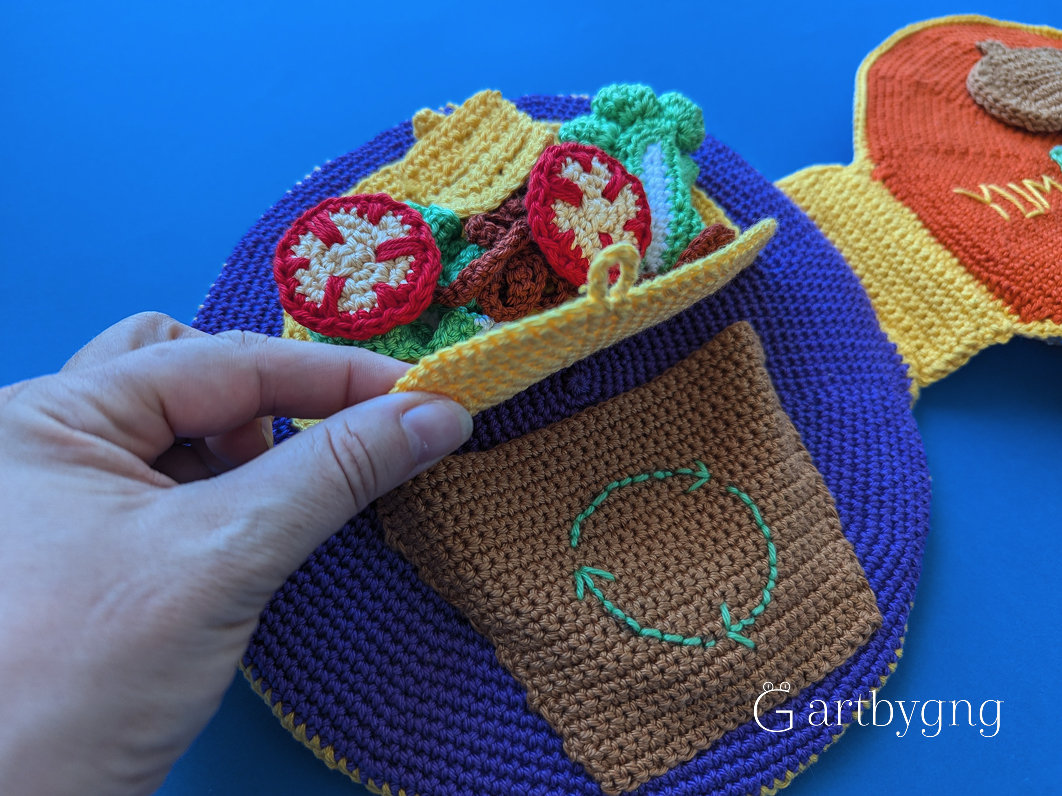
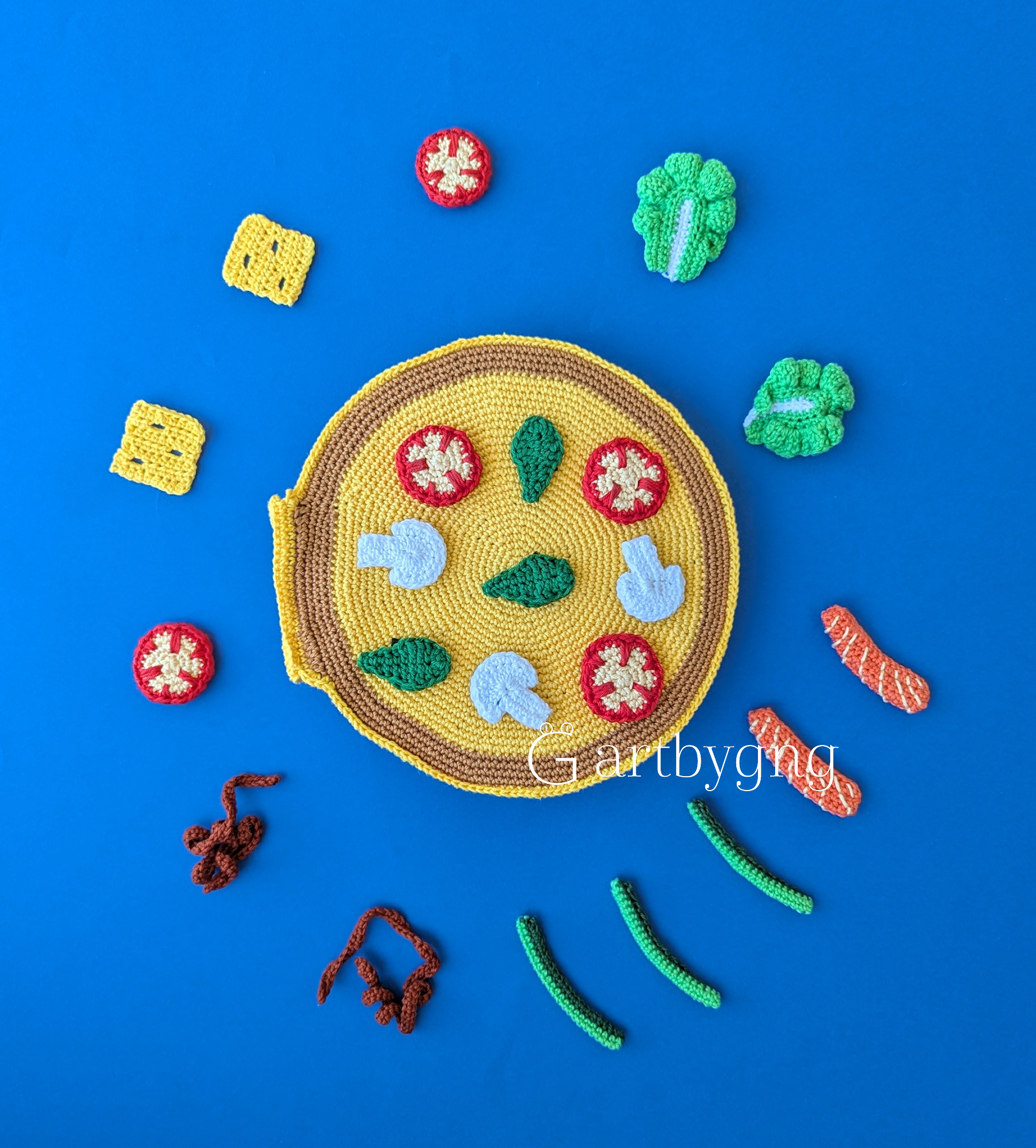
The interaction: a pocket a toddler fills and empties on repeat. A grocery bag full of crocheted play-food pieces which can be placed in the taco and back in the bag once it’s been “eaten”.
What you’d crochet: one taco (just a circle), a grocery bag, and a small set of amigurumi play food (like minced meat, lettuce, tomato — scrap-yarn sized).
Skill level: beginner to intermediate; the food pieces are classic small amigurumi.
My Fun Foods pattern is a whole collection of amigurumi play food mechanisms designed for play as well as learning about different foods.
5. Fix it tools
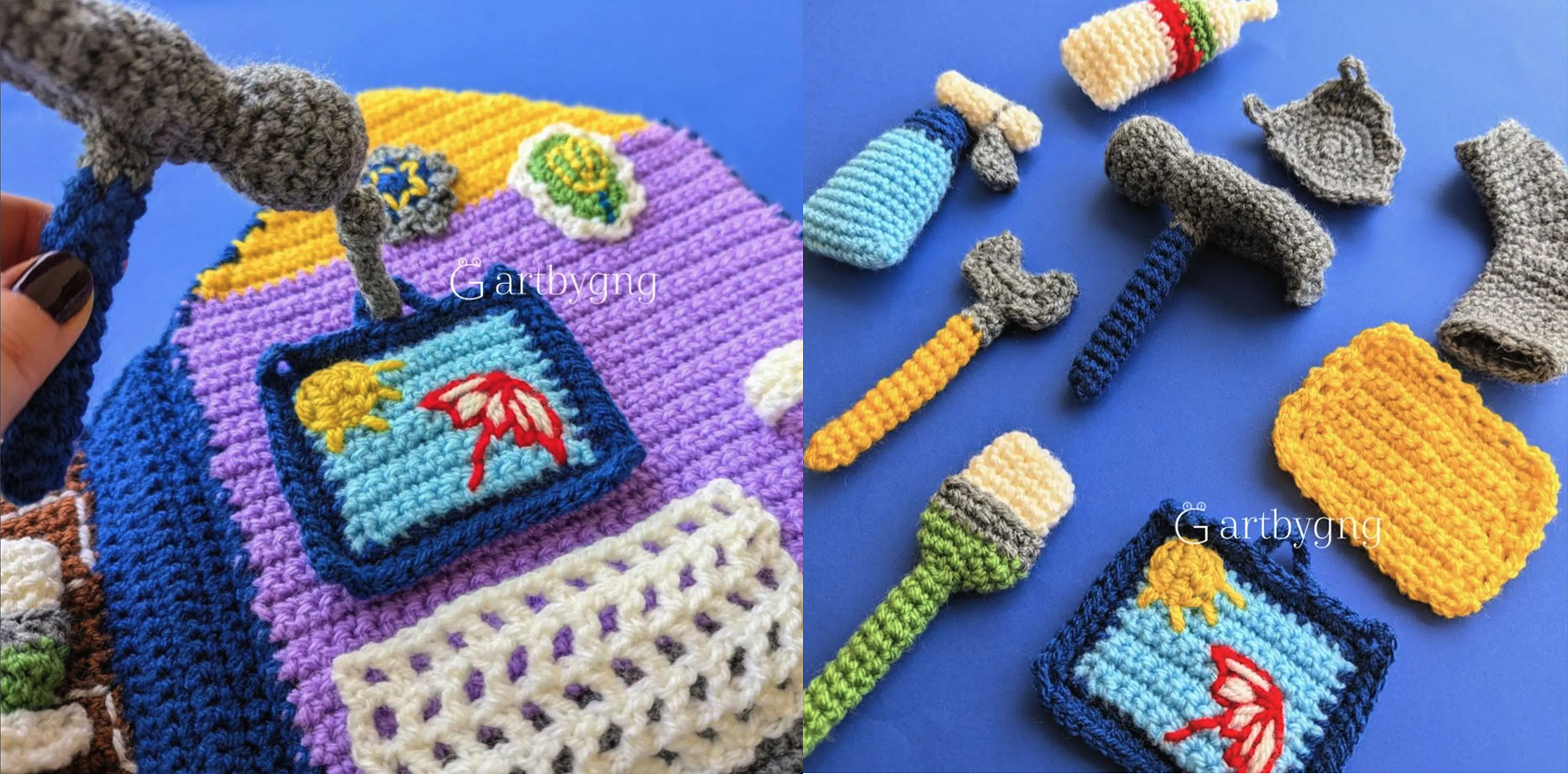
The interaction: pieces that hang, slot, or line up onto matching outlines. A little pegboard or toolbox scene holds crocheted tools — a hammer, a wrench, a screwdriver — that attach onto their matching silhouettes with Velcro or hook onto loops. It’s shape-matching and hand-eye practice with a “helping grown-ups” story kids love.
What you’d crochet: flat/plushy tool shapes plus matching outline appliqués (or small loops to hang from).
Skill level: intermediate — the shapes of the pieces can get tricky.
If a build-and-fix theme is your kid’s thing, my Home Improvement quiet book pattern leans into this world.
6. Match the socks
The interaction: finding the two pieces that make a pair. A little clothesline stretches across the page and a jumble of socks (or mittens) in different colors and patterns waits below; the toddler hangs each one and finds its matching partner. You can create the hanging mechanism by adding a chain string to each item and use a ring-hitch knot to attach it to the line.
What you’d crochet: a clothesline (a simple crocheted line) plus three or four pairs of little socks or mittens, each pair a distinct color or simple pattern, with a chain attached to them.
Skill level: beginner — every piece is small, flat, and fast, so it’s a lovely scrap-yarn page, and with no buttons or hard parts it’s a safe pick for the youngest crowd.
7. Count the apples on the tree
The interaction: removable pieces that come off and go back on, with a number to them. A tree (or bush) sits on the page and a set of little apples attach with Velcro; the toddler picks them, counts them, and puts them back. Add a small basket pocket at the base to add another dimension to the play.
What you’d crochet: one flat tree, a few small apples, and an optional pocket basket.
Skill level: beginner-friendly — the apples are simple circles with numbers embroidered on them. Swap apples for pumpkins, oranges, or ornaments to reuse the page for different seasons.
8. Match the cupcake to the liner
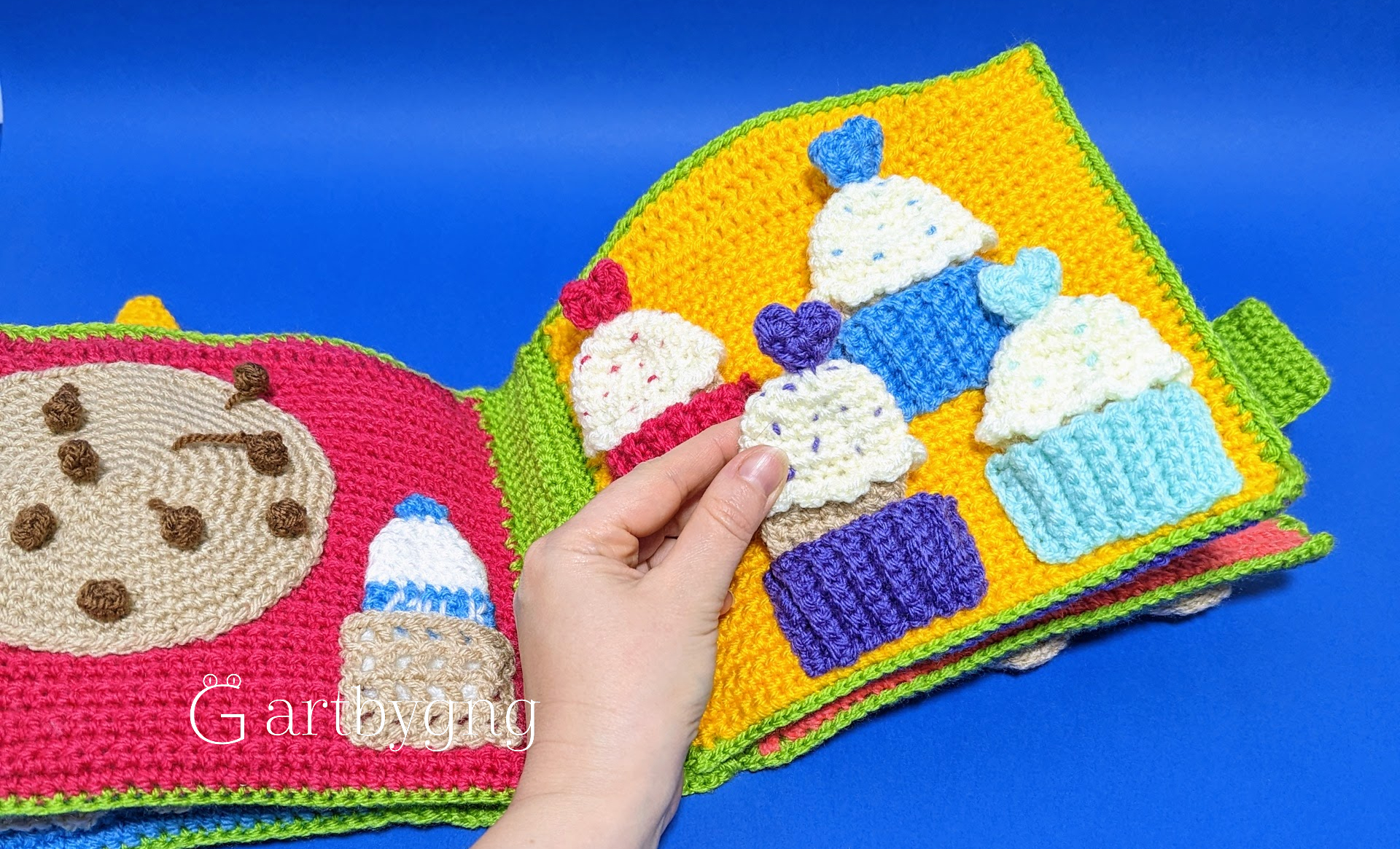
The interaction: matching pieces by color. A group of liners spread out on the page, each a different color, and a set of cupcakes with elements in the same colors to place in the matching liner (tuck into the liner, or attach with Velcro). Color-matching is a fun and easy skill to learn, especially when cupcakes are involved.
What you’d crochet: three or four little liners (pockets/appliques), and a matching cupcake for each.
Skill level: beginner to intermediate. The shapes can get more complex depending on how you make the pieces. Because the pieces repeat in different colors, it’s a great stash-buster.
9. Match the shapes
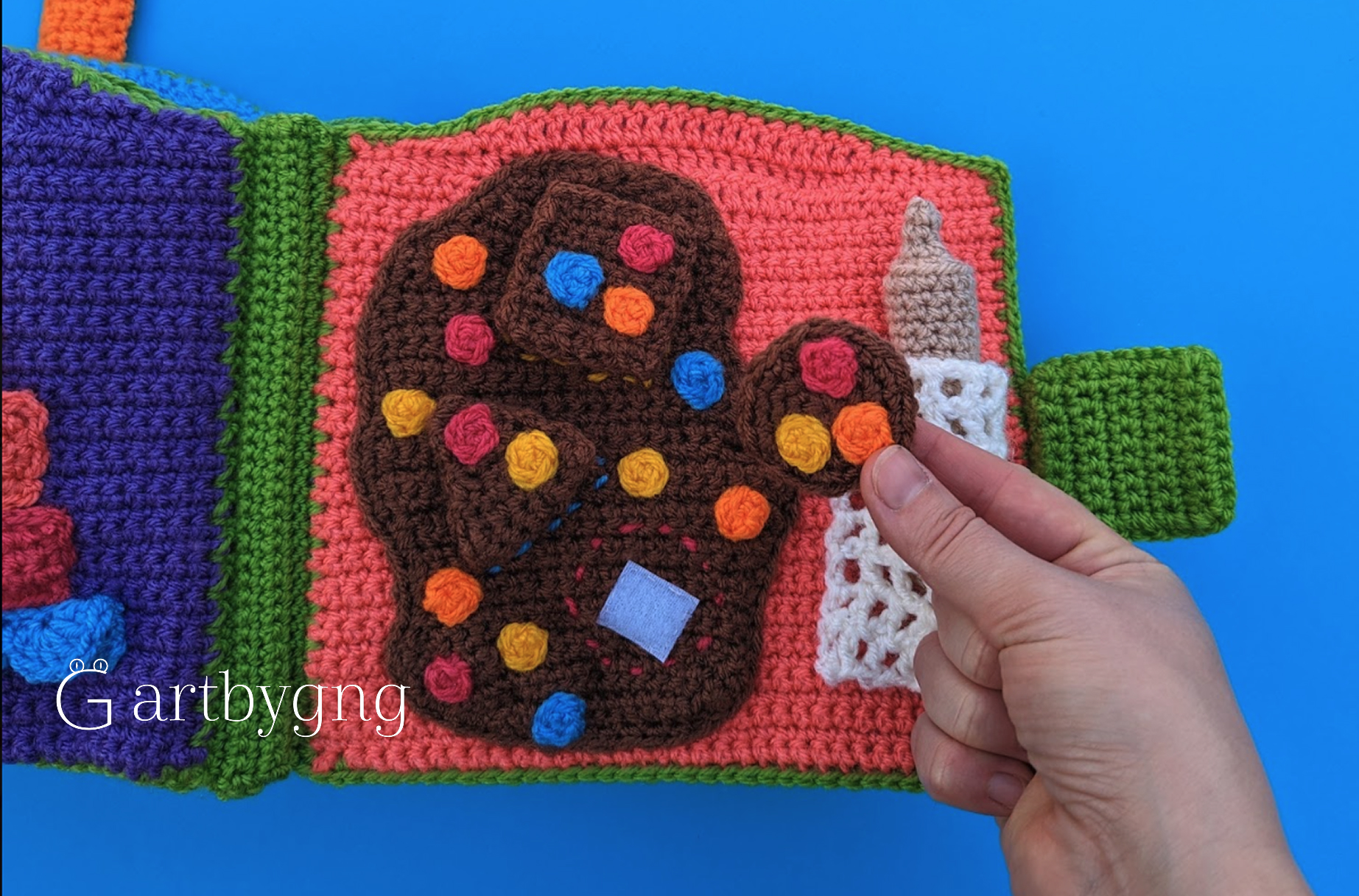
The interaction: fitting a piece into its matching outline — a soft shape sorter. Crocheted shapes (circle, square, triangle, star) fit onto matching silhouettes on the page, so the toddler has to spot which shape goes where. It’s the shape-sorter toy flattened into a page, minus the hard plastic.
What you’d crochet: a set of flat shapes plus their matching outline appliqués, with Velcro to hold each in place.
Skill level: Beginner. You can keep the shapes basic, or “dress them up” with themes, like shown in the picture above take from my Bake time quiet book pattern.
10. Dress for the weather
The interaction: a spinner or dial that changes, plus pieces to match to it. A little weather dial (sun, cloud, rain, snow) that turns, paired with clothing pieces — a hat, boots, an umbrella — the toddler matches to today’s weather. It layers two interactions: turning the dial and choosing the right piece.
What you’d crochet: a round dial with a fastener through the center so it spins, plus a few small clothing pieces. Skill level: intermediate — both the spinner mechanism and the clothes might require a bit more practice/research.
11. Lace up the shoe
The interaction: threading a lace through holes. A big crocheted shoe or boot with eyelet holes and a cord to lace through (attached at the bottom of the shoe for safety), back and forth, and tie at the top. Lacing is a great fine motor practice for toddlers, and it’s a life skill in miniature.
What you’d crochet: one oversized flat shoe with reinforced eyelets (can be created by skipping stitches) and a sturdy crocheted cord or ribbon.
Skill level: Beginner to intermediate — mostly simple, shaping the shoe might take a couple of tries to get it just right.
12. Get dressed: zip, snap, buckle
The interaction: working real fastenings — a zip, snaps, a buckle. A “getting dressed” or jacket page with actual accessories sewn on: a short zipper, snaps, velcro. This is the classic busy-board skill set, softened into a book page, and it’s the page grown-ups quietly find satisfying too.
What you’d crochet: a jacket to attach the different options to; the fastenings themselves are store-bought accessories sewn on securely. Skill level: intermediate — not because of the crochet, but because attaching a working zipper and buckle neatly takes careful sewing.
13. Make a silly face
The interaction: mix-and-match features onto a crocheted face. A head shape on the page, and a set of swappable eyes, noses, mouths, ears, and hairstyles that attach with Velcro so the toddler builds — and rebuilds — a face. Endlessly funny to a two-year-old, and quietly teaching them face parts and expressions.
What you’d crochet: one large face base plus a pile of small features (several of each).
Skill level: beginner to intermediate — every piece is small and flat, so it’s a great scrap project; the variety is what makes it feel rich, and you can choose simpler/more complex techniques.
14. Tuck teddy into bed
The interaction: putting a character to bed under a lift-up blanket. A little bed applique sewn to the page with a blanket flap, and a small amigurumi teddy (or bunny) the toddler tucks in, covers up, and wakes again. It’s a nurturing, calming page — a lovely note to end a book on, and it doubles as part of the bedtime routine.
What you’d crochet: a bed appliqué with a blanket flap (attached along the side edge so it lifts), a pillow, and one small stuffed character.
Skill level: intermediate — the teddy is a small amigurumi, so it’s the most “toy-like” make on this list, but still palm-sized and simple.
How to Turn These Ideas Into an Actual Book
I recommend picking one theme and “dressing up” the mechanisms on the pages according to it. A themed book tells a story and is easier to shop for — colors and pieces repeat, so your yarn stretches further and the pages feel like continuous pieces instead of different samples. You can use most of the suggestions above and slightly change them to fit your theme. For example, the cake with the toppings could be changed to a face with many different hats.
4-8 pages in a quiet book usually works well — enough to feel like a real book, small enough to actually finish, and because pages are joined back-to-back into leaves, plan an even number. Give each page just one clear interaction; one good game per page beats three cluttered ones.
Then it’s the build order every quiet book follows: crochet matching base pages, create the background scenes, make the interactive pieces, assemble the pages, and join the pages into a book. The full beginner’s guide walks through every step, including the assembly stage for a finished piece.
Would You Rather Skip the Design Work?
Every idea here can be designed from scratch — but designing means sizing each piece by trial and error, working out how every interaction attaches, and solving assembly on your own. Could be really fun! But a bit more work.
A good pattern will have had these steps done already, so you don’t have to. My patterns are step-by-step, photo-guided PDFs where every page, piece, and interaction is already worked out and play-tested. You bring the yarn and the evenings, the design decisions are already made. Several of the ideas above are from my patterns: Bake Time (decorate the cake), Painter (paint at the canvas), Busy Beehive (feed the bees), and Fun Foods (stuff the taco).
Browse all my crochet quiet book patterns on Etsy →
And if you’re not sure a pattern is in your range, here’s what “skill level” actually means for my patterns — spoiler: if you have some crochet experience, you have what you need to get started.
FAQ
What makes a good quiet book page?
One clear interaction. The best crochet quiet book pages give little hands a single thing to do — decorate, sort, tuck away, button, or move a piece — rather than just showing a pretty picture. Pick one game per page, make the pieces toddler-sized, and attach everything securely.
What are the easiest quiet book pages for beginners?
Start with pages built from small, simply shaped pieces: match the shape, paint the canvas, or count the apples. They require relatively simple shaping — no complicated mechanics — so they’re the fastest to finish and great to start with.
Can I mix ideas from different themes in one book?
Absolutely. Use the ideas and the mechanisms and match them to your theme, if you chose to have one. Let your imagination run free and don’t be afraid to try your own ideas.
Your Next Page Starts Tonight
Hopefully this post game you some ideas and got you excited about creating 😊
Want it worked out for you instead? Pick a pattern and let the theme pick you.